

1. Is “Waiting to Sell” a Risk or a Strategy?
In traditional agricultural thinking, delaying sales after harvest is often viewed as:
- a high risk of spoilage
- an additional storage cost burden
- a threat to cash flow
However, evidence from postharvest economics and supply chain management reveals a different reality:
👉 The ability to sell at the right time is one of the most powerful profit levers in the agricultural value chain.
The key question is not whether to wait, but whether the business has the capability to preserve quality while waiting.
2. Agricultural Price Volatility: A Missed Opportunity
Agricultural commodity prices are highly influenced by:
- seasonality
- supply surges during peak harvest
- export logistics delays
- fluctuations in import market demand
Market data consistently shows:
- prices during peak harvest are typically the lowest of the year
- prices 1–3 months after harvest can increase by 30–80%, depending on the crop
Yet many producers and exporters fail to capture this upside because product quality cannot be maintained long enough.
3. The Cost of Selling Too Early
When businesses are forced to sell immediately after harvest, they:
- lose pricing power
- accept pressure from intermediaries
- lack flexibility in market allocation
This leads to a common paradox:
The highest production volume often coincides with the lowest profit margin.
Ironically, postharvest preservation costs usually account for only 5–12% of total product value, yet they determine 100% of the ability to wait for better prices.
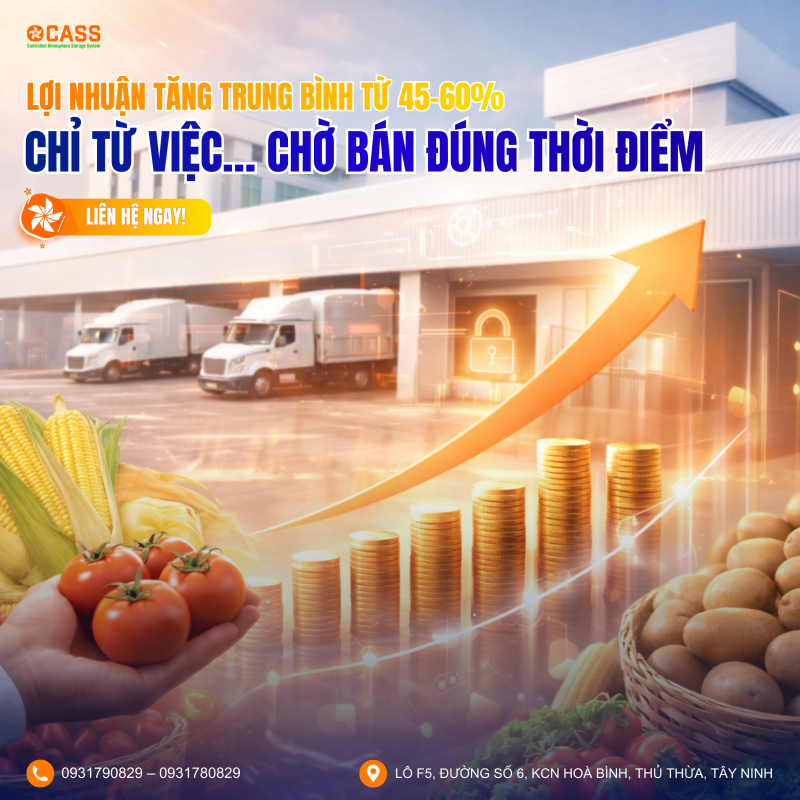
4. Why Profits Increase by 45–60%
The average profit increase of 45–60% is not driven by:
- higher yields
- expanded cultivation areas
- increased marketing expenditure
Instead, it results from four compounding postharvest advantages:
4.1. Selling at Higher Market Prices
Price differentials between peak season and off-season typically reach:
- +30–50% for fresh fruit
- +50–80% for export-grade produce
4.2. Reduced Postharvest Losses
Typical postharvest losses:
- 20–30% under conventional storage
- <5–10% with advanced atmosphere-controlled storage
➡ Profit gains come not only from higher prices, but also from higher sellable volume.
4.3. Consistent and Export-Grade Quality
Maintaining:
- firmness
- sweetness
- color
- nutritional value
allows products to:
- access premium market segments
- meet export specifications
- reduce rejection rates and customer claims
4.4. Optimized Cash Flow and Sales Planning
Instead of selling everything within weeks, businesses can:
- distribute sales monthly
- balance cash flow
- synchronize logistics with market demand
➡ Profitability becomes strategic rather than reactive.
5. The Role of Advanced Preservation in “Waiting to Sell”
To wait without losing quality, businesses must:
- significantly slow respiration
- control ripening and senescence
- minimize moisture loss
- maintain stable storage conditions
Modern solutions such as
CASS – Controlled Atmosphere Storage System
enable businesses to:
- reduce respiration rates
- extend safe storage duration
- preserve near-harvest quality
➡ Time becomes a value-generating asset rather than a liability.
6. Waiting Is No Longer a Cost — It Is an Investment
With proper preservation capability:
- every additional storage day is a strategic option, not a delay
- storage facilities become profit centers, not cost centers
Extended storage time equals pricing flexibility.
7. Conclusion
A 45–60% profit increase does not come from producing more —
it comes from selling smarter.
Successful agribusinesses are those that:
- are not forced to sell during peak harvest
- are not dependent on intermediaries
- can decide when to sell, how much to sell, and to which market
And it all starts with one critical capability:
The ability to preserve quality long enough to sell at the right time.
——
CÔNG TY TNHH BẢO QUẢN RAU QUẢ CASSS
• Hotline: 0931790829 – 0931780829
• Email: cass@cass.vn
• Website: cass.vn
• Địa chỉ kho (trước sáp nhập): Lô F5, Đường số 6, KCN Hoà Bình, Huyện Thủ Thừa, Tỉnh Long An
Địa chỉ kho (sau sáp nhập): Lô F5, Đường số 6, KCN Hoà Bình, Xã Thủ Thừa, Tỉnh Tây Ninh